Showing posts with label Artist of the Week. Show all posts

Friday, May 25, 2012

Artist of the Week no. 11

Oceanic Art


The artwork of the Oceanic People was something I planned on teaching this year to my beginning students and while we may not have focused much on it in class I really wanted to share some images and facts on here regarding Oceanic Art.  I found this information and these images most inspiring and powerful because of our recent trip to Hawaii.  A place so scared, I didn't actually want to go to as a tourist.  After much resistance to my mom's offer, we gave in and spent six days on the beautiful island.  I found these people and their artwork most interesting because of the use of materials.  They are island dwellers and therefore have only the supplies of the island to construct visual images.  Their complete use of materials is something I greatly respect and believe all artists should aspire to. Waste is not beautiful nor beneficial.


Oceanic Art is the creative work made by the native peoples of the Pacific Islands and Australia. Hawaii and Easter Island are part of these as well.

There are four regions, they include...
Polynesia (Hawaii and surrounding)
Micronesia
Australia
Melanesia

Polynesia and Micronesia are both from the ancestral culture; Lapita.   

ALL of the regions were greatly (and not in a good way - in my opinion) affected by Western influence and colonization. Although, the creations of these people varies, the subject matter remains mostly the same; fertility and the supernatural.

 Masks are commonly used in religious ceremonies, and other art forms include; petroglyphs (rock engraving), tattooing, painting, wood carving, stone carving, and textile work are the most common art forms.

Australia
 Australia’s first native people are Aboriginal. They came to New Guinea and Australia about 40,000-60,000 years ago. The second came from Southeast Asia. These people lacked writing systems and made art on perishable (not lasting for long) materials. Oceanic people did not think of their work as art, but more as objects created for the practical purpose of use in religious ceremonies, or for use in everyday life. Rock art of Aborigines is the longest continuously practiced artist tradition in the world. They are most known for their rock art, which they still practice even after their contact with Western explorers. They are also known for their dot paintings and are known for dance paintings where they dance with paint on their bodies.

Australia has 3 time periods:
Pre-Estuarine (40,000-6000BC), Oldest and known for red ocher pigment.
Estuarine (6000BC-500AD) when increasing elaborate images appear.
Fresh Water (500AD-Present).

Rock paintings served several functions; ceremonies and amusement. One of the most elaborate collections of rock art in this area is the site Ubirr, a camping ground during wet seasons which has had its rock faces painted many times over thousands of years.

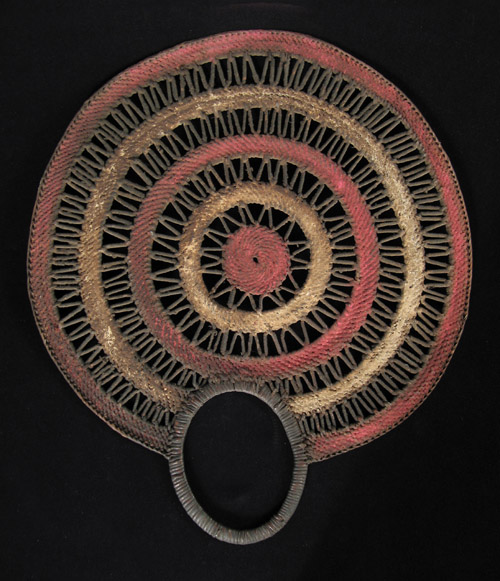
A headdress from New Guinea

Sculpture first appears in Oceania art in New Guinea as a series of stone figures throughout the island. The oldest dates to 1500 BC.

 There are three types of sculptures:
1. Mortars – tops contain images and sometimes geometric patters
2. Pestles –tops contain images, often birds or human heads
3. Freestanding figures - humans, animals, and phalluses.


Lapita (ancestors to Polynesia, Micronesia) 
Their art is best known for its ceramics. The pieces contain geometric motifs and sometimes anthropomorphic images. Some of the designs may be related to modern Polynesian tattoos and barkcloths. They were created by firing a comblike tool that stamped the designs on to wet clay. The ceramics were used in cooking, serving and storing food. It was functional.


sourceCeramic pieces with the patterns. 


Micronesia is second wave settlers of Oceania. 
Wood carving by men flourishes in the region. Stylized bowls, canoe ornaments, ceremonial vessels, and sometime sculptured figures. Women created textiles and ornaments, like bracelets and headbands. Micronesian art is simple and functional, but usually high standard of quality. They made the best possible use of what few natural materials they had available to them. After western cultures influenced the Micronesia people sculptural art forms ceased to exist. But architecture and weaving continued. In the 20th century there was a revived interest in traditional art forms. 

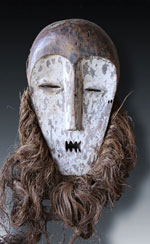
Mask from the Maori culture of New Zealand 

Polynesia is also from Lapita’s culture. They include Hawaiian islands, New Zealand, Tahiti, and Easter Isalnd. Polynesian art is characteristically ornate and often meant to contain supernatural power. In the 19th Century, depopulation of areas due to slave raiding and Western diseases disrupted many cultures. Because of the conversion to Christianity, the loss of many tradition cultural and artworks occurred, specifically sculpture. Secular art forms continued, such as carving and textile work.

Melanesia 
Typically the art is highly decorative and portrays exaggerated forms, often of sexual themes. It’s mostly made in connection with ancestors, hunting and cannibalism. Often they they used the context of spiritual rituals, for example; elaborate masks. After the 1600 and the increase of European explorers much of their art was lost.

In 1600, Melanesia, like the other regions of Oceania, saw increasing encounters with European explorers. It wasn't until the latter half of the 19th century however, that westernization began to takes its toll. Some traditional forms of art went into decline, but others like sculpture survived and even thrived in the region. Not until more of the islands was explored by the western powers that the sheer diversity of Melanesian art began to be seen. By the 20th century, Melanesian art began to find its way to the West and had a profound impact on contemporary artists. However, a great cultural disruption followed the WWII, and much traditional art began to decline or be destroyed. This was followed decades later by a new found appreciation for their native art forms.

Sources 1. 2.

want a simple version of these notes? The Google Doc of my notes handout for my students available here.

Happy Oceanic Art Educating.  

If you have more references and or information about oceanic art I'd love to see it, link it in the comments below!

Monday, April 30, 2012

Artist of the Week No. 10

Eva Hesse.
Art Movement: Postminimalism

Untitled (Rope Piece) 1970

Eva Hesse was born in Hamburg, Germany on January 11, 1936.  She was a German-born American sculptor, and is known for being one of the first to work in such diverse materials such as latex, fiberglass, and plastics.


Early life Hesse was born into a family of observant Jews in Germany.  When Hesse was two years old, during the Nazi occupation, her parents sent her and her older sister to the Netherlands via Kindertransport. After a few months of separation, the reunited family moved to England and then, in 1939, emigrated to New York City.

Contingent, polymer, 1968

Sadly, in 1944 Hesse's parents separated.  Although, her father remarried in 1945, it was a tragic for her when her mother committed suicide in 1946 when Hesse was only 10 years old.


Hesse had worked and been educated as an oil painter, watercolorist, lithographer and sculptor.  She attended and graduated from New York's School of Industrial Art in 1952.  Hesse also studied at New York's Pratt Institute (1952–1953) and Cooper Union (1954–1957), then at the Yale School of Art and Architecture (1957–1959), where she studied under Josef Albers and received a Bachelors of Fine Arts.

Eva Hesse, S-105. Fibreglass, polyester resin, plastic.

In 1961, she met and married sculptor Tom Doyle.  In August 1962, Eva Hesse and Tom Doyle participated in an Allan Kaprow Happening at the Art Students League of New York in Woodstock, New York.  It was there Hesse made her first three dimensional piece: a costume for the Happening.

Repetition Nineteen III, 1968

Her and her husband returned to Germany for about a year during 1964–1965. But, Hesse was not happy to be back in Germany, and began sculpting with materials that had been left behind in the abandoned factory the couple was living in.  Her first pieces were relief sculptures made of cloth-covered cord, electrical wire, and masonite, with playful titles like Eighter from Decatur and Oomamaboomba. her relief sculptures were inspired by the qualities of string and plaster. From reliefs she moved to objects, using papier mache, paint, tubing, dyed nets and dangling string. Hesse loved the irregular shapes, surfaces and translucency that these materials produced. Hesse often created elaborate, handmade pieces involving obsessive repetition.  Although, many of her later pieces made of metal and fiberglass, she left the fabrication to outside companies. During the late 1960s, it was popular to remove the appearance of the artist's hand from the work. For Hesse, she did so more for practical reasons than intellectual ones.


She returned to New York City in 1965 she began working in the materials that would become characteristic of her work. Hesse discovered latex (a material she knew would eventually deteriorate), fiberglass and polyester resin.  Hesse had an interest in painting in the earlier stages of her career, as well in drawing, as evinced by her numerous workbooks.

She was associated with the mid-1960s postminimal anti-form trend in sculpture.

In September 1968 Eva Hesse began teaching at the School of Visual Arts.  Her only one-person show of sculpture in her lifetime was "Chain Polymers" at the Fischbach Gallery on W. 57th Street in New York in November 1968; her large piece Expanded Expansion showed at the Whitney Museum in the 1969 exhibit "Anti-Illusion: Process/Materials".  Since her death there have been many exhibitions in the United States and Europe, including at The Guggenheim Museum (1972), the San Francisco Museum of Modern Art (2002), The Drawing Center in New York (2006) and the Jewish Museum of New York (2006).

Except for fiberglass, most of her favored materials age badly, so many of here pieces are challenging for curators to display.

It was in 1969, that she was diagnosed with a brain tumor. Her death May 29, 1970 at age 34 ended a career spanning only ten years.

Hesse was a pioneer of Feminism in the art world.  She always felt she was fighting for recognition in a male dominated art world and as an art teacher at an all girls school, I always make a point to teach about her specifically, not only because she was a minority nor because she escaped the holocaust but because her work was ground breaking.  It takes the discarded materials of industrialization and reinvents them, utilizing their texture and lines.  

She is considered one of the few artists who progressed Minimalism to Postminimalism.


Friday, February 10, 2012

Artist of the Week No. 9

This week my students and I looked at a current artist, Caia Koopman.


Caia Koopman is a preeminent female artists living in California.  Koopman is a native of California and was born in Livermore. She received her Bachelor of Arts in Fine arts from UC Santa Cruz.  During her time in Santa Cruz she became involved in the skateboarding and snowboarding scenes.  Koopman has a fine detail for beauty, inclinations toward nature, and collectiveness of the female spirit.  She has quickly become one of the quintessential artists fully encompassing the elegance, strengths, and vulnerabilities of femininity. 


Her work is alluring and has a hint of whimsy. There is a fascination of women, in both our conscious and subconscious ideals of the feminine role in society.  Koopman consistently submerses herself in subject that matter that is ingrained and full of cultural connotations.


Koopman's work is infused with a variety of cultural, political, environmental, sociological, and dreamscape references. 


After earning her art degree, she turned her attention to snowboarding and spent many winters following the snow. It was her love for the sport that inspired Caia to strive for a career creating snowboard graphics and later branching out to become a commercial artist and finally a fine artist as well.   Caia Koopman is a native of California and was born in Livermore.  Koopman's paintings have been used commercially for many years as graphics for snowboards, skateboards and wakeboards. Koopman has shown her paintings in a number of galleries around the world and most recently at La Luz de Jesus in LA. She is currently working as a freelance illustrator and painter in Oceanside, CA.


Caia is inspired by nature, dreams, politics, and life.


Sources: http://www.caiakoopman.com 
lots of lovely images tagged here.

When discussed with my students this is what we decided about her work;
Her female figures are posed.  They have big eyes, their faces are distorted, their hands and arms are long and skinny.  Their heads are big for their bodies, eyes are big but mouth and nose are small.  They are often wearing dresses, and are fashionable.   Her pieces always contain animals.  Which might represent peacefulness, hope.  She incorporates NATURE, flowers, leaves, insects.  Many of her pieces are conveying dark emotions or are depressing.  Imagery she uses to make the viewer feel eerie include skulls, black, dark outline around eyes, facial expressions.  The female figures seem cartoonish, because they're not proportionate, almost like a caricature. They wear lots of make up; which might portray vulnerability, the make up covering up imperfections.  The Element most present is color; brings the picture together and sets the mood. The Principles most present are Unity is possible because of her color choices and Emphasis; she often will back light, white splatters or glowing effect behind the girl

Thursday, January 12, 2012

Artist of the Week No. 8

African Art and El Anatsui 

Some basic facts about Africa:
Africa is south of Europe.
In between the Atlantic and Indian Oceans.
More than 1,000 Languages have been identified.
The major religion that influenced Africa was Islam (done peacefully).
1914 under colonial rule
1945-1970s colonies gained independence one after another.
During the 20th century, the art of tradition African societies played a pivotal role in revitalizing the Western art tradition.

African Artifacts
African Art influenced furniture in the Art Deco time period. In some African cultures, elaborate stools or chairs were created not only to indicate their owners’ status but also to serve as alters for their souls after death. The example of the chair is from the Ngombe people who live along the Congo River. When France began to colonize Africa in the late 19th century and African objects were brought by French soldiers, administrators and adventurers.
Pierre Legrain. Tabouret, 1923

Homes and Dwellings
Nankani People create living spaces or dwellings in a cooperative but gender specific project.
Men build the structures and women decorate the surfaces. The dwellings are also gender specific the round dwellings are for women the square are for the men. (page 879 of Art History, Stokstad, second edition, volume 2) The dwellings or homes are a painted adobe architecture.

Children and Fertility Figures
Children are important in many cultures because they are what keeps that culture going; many children still die before age 5. Many women can not have children and are blamed for this, it’s rarely the man’s fault, the women carry fertility figures. Fertility figures are considered art.

Twin figures are important because if one twin dies the other twin is at risk.
These are Ibeji statues from the Yoruba people in Nigeria. They believe that twins share one soul. If one twin dies and goes to the spirit world, then the living twin is in danger. Mom has to go to a diviner and commission an Ibeji for her dead child. For the rest of her life, she must feed, take care of, make sacrifices to, and love the statue like her child. This keeps her dead child in the spirit world happy. This way, the living child’s soul remains intact.
Mom with her figures 1974

The Yoruba are an important ethnic group mainly occupying Southwestern Nigeria. Mainly for genetic reasons, this very large tribe happens to present the highest dizygotic twinning rate in the world (4.4 % of all maternities), more than any other ethnic group in the world. They even have special names for twins: Taiwo and Kehinde.

For babies that are born as multiple births (triples and such) Taiwo is the twin that sees the world first while Kehinde follows. Idowu is the child born after Kehinde, Alaba is born after Idowu and Igogbe is born after Alaba.

Spirits and Masks
Among the most potent images of power in African Art are the nkisi, or spirit, figures made by the Kongo and Songye people of the Congo.
Example of a Bwami Mask. source.

Kente {textile} Cloth


El Anatsui is a contemporary artist using this style with found/trash materials:


Anatsui was born in 1944.  He is a Ghanaian sculptor active for much of his career in Nigeria. Anatsui was born in Anyako, and trained at the College of Art, University of Science and Technology, in Kumasi, in central Ghana. He began teaching at the University of Nigeria, Nsukka, in 1975, and has become affiliated with the Nsukka group. Some of his recent works resemble woven cloths such as kente cloth. Anatsui also incorporates uli and nsibidi into his works alongside Ghanaian motifs.

And that's my Artist of the week
Download my student's handout by clicking here.

More Sources:
http://www.randafricanart.com/Yoruba_Customs_and_Beliefs_Pertaining_to_Twins.html
http://arthistory.wisc.edu/ah241/10.html
http://www.corbisimages.com/stock-photo/rights-managed/CT001177/nankani-woman-painting-a-hut
http://www.christies.com/LotFinder/lot_details.aspx?intObjectID=4005624
http://representingplace.wordpress.com/2010/03/10/el-anatsui-in-chelsea/

Wednesday, December 28, 2011

Artist of the Week No. 7

Pop Art Featuring Andy Warhol and Roy Lichtenstein

I will be teaching Pop Art to my high schoolers in a few weeks and thought I'd share some of my notes and thoughts with you all over here on my Artist of the "week" feature.  So here's what I have so far...

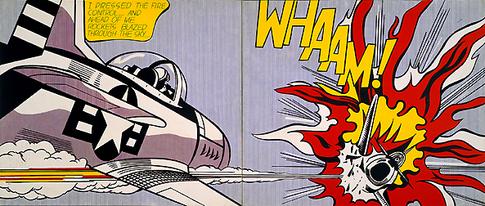
Since 1962 Lichtenstein has parodied the mindless violence and sexless romance {or romance-less sex} of comic strips to reveal the absurdity of American culture.
from here.
from here.

“It was hard to get a painting that was despicable enough so that no one would hang it.  Everyone was hanging everything.  It was almost acceptable to hang a dripping paint rag.  [But] the one thing everyone hated was commercial art.  Apparently they didn’t hate that enough either.” -Roy Lichtenstien

from here.

Lichtenstein’s work is that of comic book techniques and subjects.  He used bright primary colors with black and white.  He outlines simplified forms, and appropriates the benday dots to exemplify the stereotyped imagery.  By working on large scale canvases rivaling those of billboards he forces the trivialness onto his viewers.

During the 1950s Artists like Lichtenstein, Warhol and Oldenburg {who all had commercial art backgrounds} based their work on images from Times Square neon signs, the mass media and advertising.

Pop art made iconic images of things like hamburgers, toilets, lipstick tubes and lawnmowers.  Common consumables now interjected into the art world simply because of their chronic consumption by the American population, art imitates life right?

above and below from here.

Pop art was easy to like.  Who can resist shiny colors and clean designs?  The mechanical quality of the paintings gave the pieces glossy familiarity.  Meanwhile, galleries full of Abstract Expressionism were left behind.  One jealous gallery posted a sign next to Warhol’s soup can exhibit, “Get the real thing for 29 cents”

Pop art was a merging of clever marketing and consumer culture.  Creating Master Artists in an instant. 

Andy Warhol (1930-87) is a name every household knows, not just those associated with the art world. 

from here.

He chose his subject matter based on what he saw in the grocery store.  Magazine covers with Marilyn Monroe on the cover, or Campbell’s soup cans reproduced in his assembly line of a studio.  The Silk Screening technique he used made it easy reproduce his images over and over again. 

“Once you being to see Pop, you can’t see America in the same way.” - Andy Warhol

Not only did Warhol force people to reexamine their everyday surroundings, he made a point about the loss of identity in an industrial society.  His commentary is not something I agree with, but in his direct approach to everything industrialized there I am in direct opposition, it’s almost as if he could be sarcastic with his thoughts, and yet, he’s not.  Which is actually quite depressing to me…

He wanted to be a machine, that’s why he worked the way he did, he's also said that he wanted everyone to look alike and think alike {what a depressing thought to me as an artist}

How disturbing it must have been inside his head.  I look at his work as a direct reminder of what mass marketing leads to.  I think of the work as a satire to daily life, even if that’s not always what the artist intended.

From all I know about Andy Warhol the thing he wanted most in life was fame.  He predicted that everyone would have at least 15 minutes of fame.  His lasted for 25 years of his life and continues on to this day, as you can see from a recent photograph I took featuring pillows and dresses with his iconic imagery silk screened onto them.

Image from a store front in Venice. 2009.


The majority of information above is from The Annotated Mona Lisa, a Crash Course in Art History from Prehistoric to Post-Modern. By Carol Strickland, Ph.D.

More information about Pop Art here.

And a list of more pop artists:

Friday, November 18, 2011

Artist of the Week No.6

Islamic Art, La Alhambra de Granada


Sadly, all of my photos from my high school Spanish trip were taken BEFORE my digital camera, so these are from the internet.

La Alhambra is a palace and fortress in Granada, Spain.  It was the last Moorish (Muslim) stronghold in Spain during the Catholic Reconquest under King Ferdinand II of Aragon and Queen Isabella I of Castile and León.  Completed towards the end of Muslim rule of Spain by Yusuf I (1333–1353) and Muhammed V, Sultan of Granada (1353–1391).  This fortress held off K. Ferdinand and Q. Isabella when they were forcing everyone to convert to Catholicism, until 1492.  Check that date.  This was built before Columbus came to America!

from here.

The Court of the Lions above is one of my favorite fountains in Spain. It was created and functioned well before indoor plumbing!

And all the mirror pools around the palace are remarkable, like the one below.
from here.

The carvings in the palace are overwhelmingly gorgeous.  They say allah is god, over and over in the most amazing calligraphy I've ever seen.  Regardless of my views on any religion as an artist I can appreciate the craftsmanship of such an extraordinary structure.
from here.
from here.
from here.

Unlike many palaces in Europe you will not see tapestries or paintings here.  It is against the Qur'an to draw human figures, as they believe only god has the power to create life (including visual creation).  But what the palace lacks in human figures it more than makes up for in geometric pattern and form.  The decadent geometric mosaics found on the walls are so intricate you could get a headache from trying to follow the artist's pattern making.  I wasn't that great at math so the tessellations created here are impossible for me to recreate in my own art.  I think that's why I have so much respect and appreciation for them.

from here.

from here.

from here.

from here.

from here.

Happy Art History Educating!

Thursday, September 15, 2011

Artist(s) of the week No. 5

Hokusai and Eastern Art.

This week my students and I are discussing Eastern and Western Art.
So, for this post I thought I'd share some artists and artworks that are most influential in the my Eastern Art Curriculum.

The artist I always discuss with my students is Hokusai and his artwork The Great Wave of Kanagawa.  This is Hokusai's most famous artwork.  It comes from his series 36 Views of Mount Fuji.  You can see the volcano in the background covered in snow, just behind the boat about to be smashed by this wave.

This wood block print was created in 1829-32 during the Edo Period and It's one of my favorite examples of Japanese artwork.  It has the line work and color scheme most common in Japanese artwork.  And I love that it has Japanese Characters in the top left corner, something common in Japanese art.

I always discuss text in artwork with my students, and symbols.  I think this is a great example of symbols and language in paintings, prints or drawings.  As art students, knowing about symbols and language reference is critical in comprehending art.  How can they make something visually read-able if they don't know how to read or write it?

Here is my Printmaking Handout for High School Students available for download.
This is my Eastern and Western Art Handout for High School Students available for download.

Other Eastern Art I like includes:
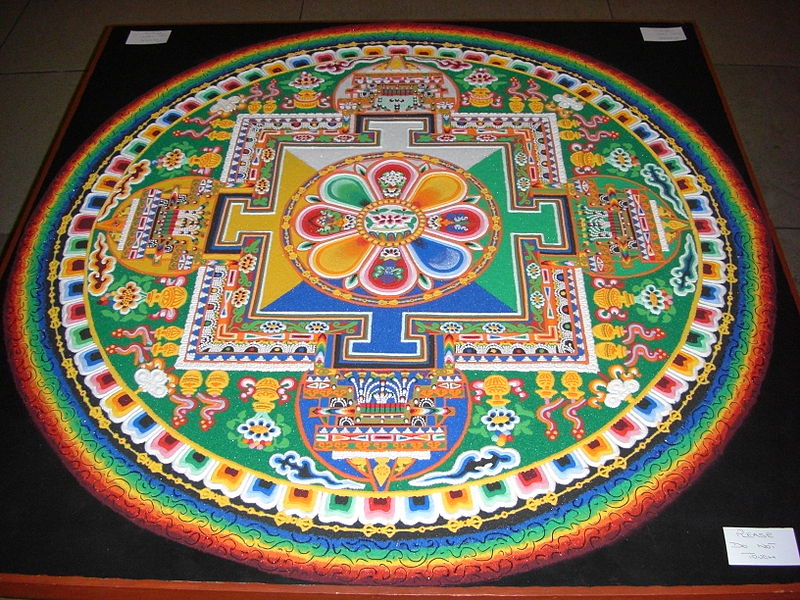
Tibetan Monks creating a mandala (here

Can you believe these are made with sand?!

I LOVE henna and Indian influenced patterns.

Do you have a favorite Eastern Artist or Artwork?  Please share it in the comments below, so I can share it with my student!

I have to admit I utilize Wikipedia but that's because I know what is legitimate and what is not, regarding art.  I find that it's the most convenient place to get the most information about artworks.